What does a Travian crop planner calculate?
The TraviTools Crop Planner compares the total lumber, clay, iron and crop cost of an upgrade with the extra crop per hour it produces. Cost divided by added crop per hour gives a simple payback time. The planner takes the best available step, recalculates the village, and repeats. That creates a build order tailored to your fields and bonuses instead of a fixed rule such as ‘always raise every field first.’
An upgrade sometimes unlocks a stronger one. The planner judges a cropland needed for the Grain Mill, or the Grain Mill levels needed for the Bakery, together with the production they unlock. It still lists each actual upgrade in order, so you can follow the result one build at a time.
Set up your 15-cropper, 9-cropper or regular village
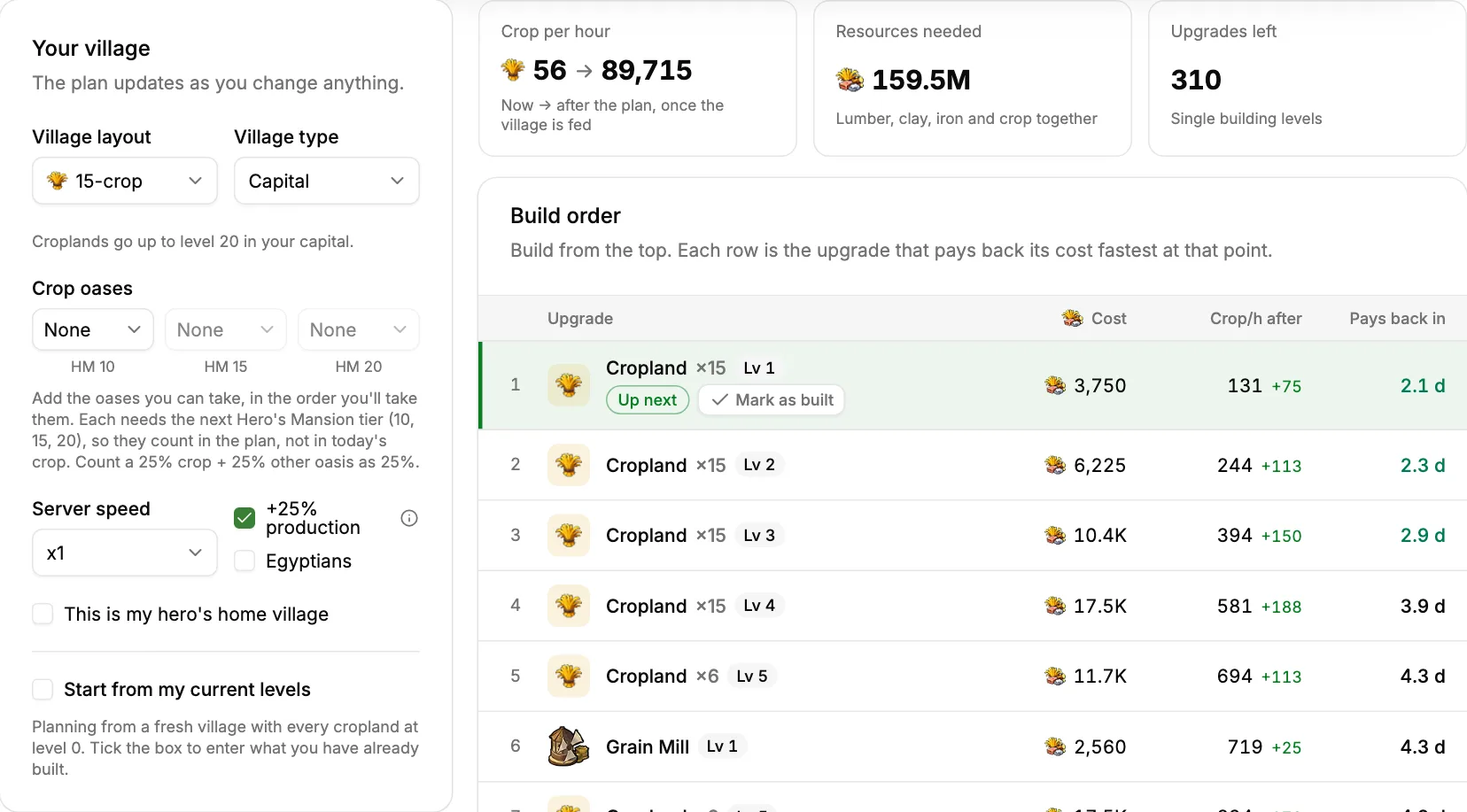
Open the planner and choose the village layout: 15, 9, 7 or 6 croplands. Then choose Capital, City on an Annual Special world, or Village. The choice matters because regular villages stop at cropland level 10, cities at 12, while the planner takes a capital to level 20, or to level 23 if you allow croplands above level 20 under Additional settings. Travian’s resource guide explains why croppers and capitals have different long-term roles.
Add crop oases in the order you expect to occupy them. A 25% crop plus 25% other-resource oasis counts as 25% crop. The first, second and third oasis need Hero’s Mansion levels 10, 15 and 20 respectively, so the planner includes those building costs before applying an oasis bonus. Choose your server speed, untick the +25% production bonus if you do not use it, and select Egyptians only for an Egyptian village. Travian’s oasis rules confirm the mansion thresholds.
For an existing village, select Start from my current levels and enter the croplands and crop buildings you already have. If this is the hero’s home village, add the hero’s resource points and whether they are assigned to crop only or spread across all resources. Signed-in players with a linked village can choose that village and keep its plan with their account.
Read the build order and payback time
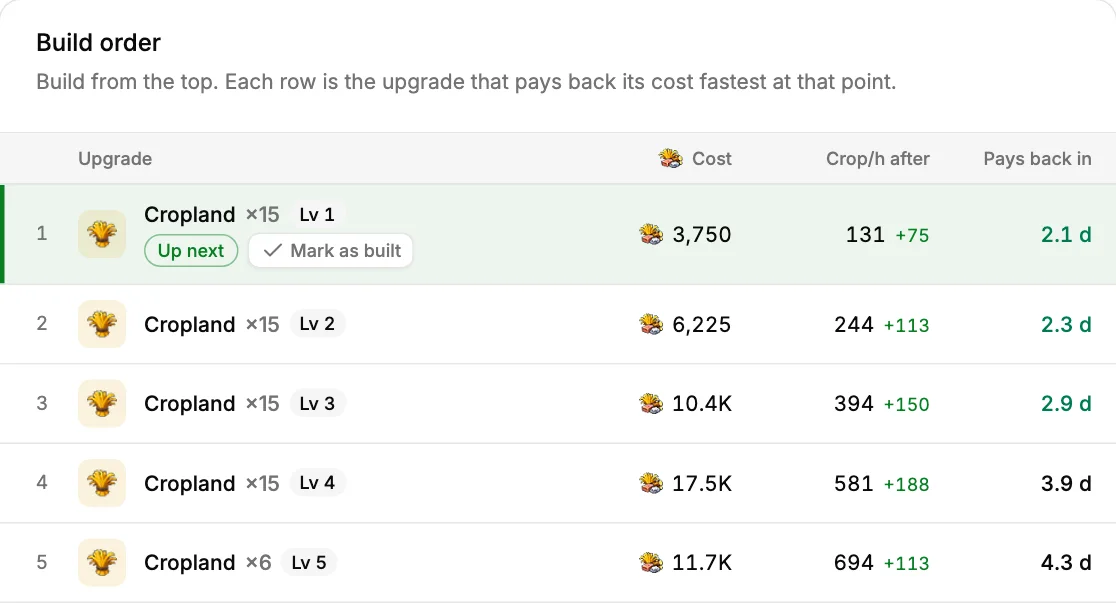
Start with the highlighted Up next row. Cost is the sum of all four resources for that step; Crop/h after is the projected hourly crop after the upgrade; the green +number is the gain from that step. Pays back in compares cost with extra hourly crop. Rows marked Needed for show a prerequisite on the way to a Grain Mill, Bakery or other crop gain.
In the fresh 15-crop capital shown below, raising all 15 croplands to level 1 costs 3,750 resources and adds 75 crop per hour. Dividing 3,750 by 75 gives 50 hours, or about 2.1 days. The exact order changes as soon as you enter different starting levels, oases or bonuses; treat the screenshot as a worked example, not a universal 15-cropper build order.
Use Mark as built after completing the first row. The planner recalculates from the new levels. This is more useful than keeping a static spreadsheet sequence when your actual village changes during play.
When should you build the Grain Mill or Bakery?
The answer depends on your whole village, not just one field. Grain Mill and Bakery bonuses affect crop production across your croplands, so they become more valuable as those fields grow. The planner compares their next levels against another cropland upgrade at each step, including any prerequisite levels still needed. An unlock can appear before the building that makes it worthwhile.
Travian lists Grain Mill and Bakery as crop production buildings. The planner’s order is an economic comparison, not a command to leave your building queue idle while you save for one large upgrade. If you need crop immediately to avoid a negative balance, build for that urgent need first.
How oases, the hero and Egyptian Waterworks change the plan
A planned oasis is not counted as current production before its Hero’s Mansion tier is reached. If the village is Egyptian, the planner can also consider Waterworks after an oasis becomes available. Those choices can move mansion or Waterworks levels ahead of another field when their combined payback is shorter.
Hero resource production goes to the hero’s home village, even when the hero is elsewhere. Set the home-village option only for that village. The +25% crop bonus is a separate premium production bonus, so untick it when it is not active. Travian documents hero production and crop upkeep and its Gold production bonuses.
What the payback estimate leaves out
Payback compares resources spent with extra crop per hour, not the time until a building finishes. The planner does not model building times, main-building speed, warehouse and granary limits, merchant deliveries or queue availability. Signed-in players with saved troops in the selected village can choose to subtract their base troop upkeep from the projected crop.
Saved troop counts are a planning estimate. The toggle uses the troops stored in My Troops for that village; it does not track troops away from home, incoming reinforcements or upkeep reductions such as the Roman Horse Drinking Trough. Check the in-game crop balance for an urgent decision.
Do not confuse the planner’s Crop per hour number with Travian’s Free crop display. The planner can include hero resource output and the +25% production bonus, while Travian’s Free crop definition excludes those two sources. If your granary is falling or troops are at risk, check the in-game crop balance before following a long-term payback recommendation.
Use the crop build order as a living plan
Begin with your real village layout and current levels, then update the plan whenever you occupy an oasis, move the hero’s home village, switch production bonuses or finish a major building. Read the first few rows as your next decisions rather than treating the full list as a promise about how many days development will take.
For broader early-game planning, pair this with the second-village build order. When you are ready to run the numbers for a specific cropper, open the Crop Planner and enter its actual settings.
Common questions
What is the best 15-cropper build order in Travian?
There is no single order for every 15-cropper. Current field levels, oases, server speed, village type and production bonuses change which upgrade has the shortest resource payback. Enter those settings in the Crop Planner to get a build order for your village.
When should I build the Grain Mill or Bakery?
Build them when their next level, including any prerequisites, repays its resource cost faster than the available cropland upgrades. The planner recalculates that comparison after every step.
Does the Crop Planner include troop upkeep?
Yes, optionally. Signed-in players with saved troops in the selected village can include their base crop upkeep. The estimate does not account for troops away from home, incoming reinforcements or upkeep reductions.
Are crop oases counted before I occupy them?
No. The planner considers a selected oasis after the matching Hero’s Mansion threshold: level 10 for the first, 15 for the second and 20 for the third.