What is rainbow farming in Travian?
Rainbow farming means repeatedly raiding an oasis with a small squad containing different troop types, usually cavalry. A Hun 1/1/1 squad means one  Steppe Rider, one
 Marksman and one
 Marauder sent together in a single raid. It does not mean three separate waves, and it has nothing to do with a literal rainbow.
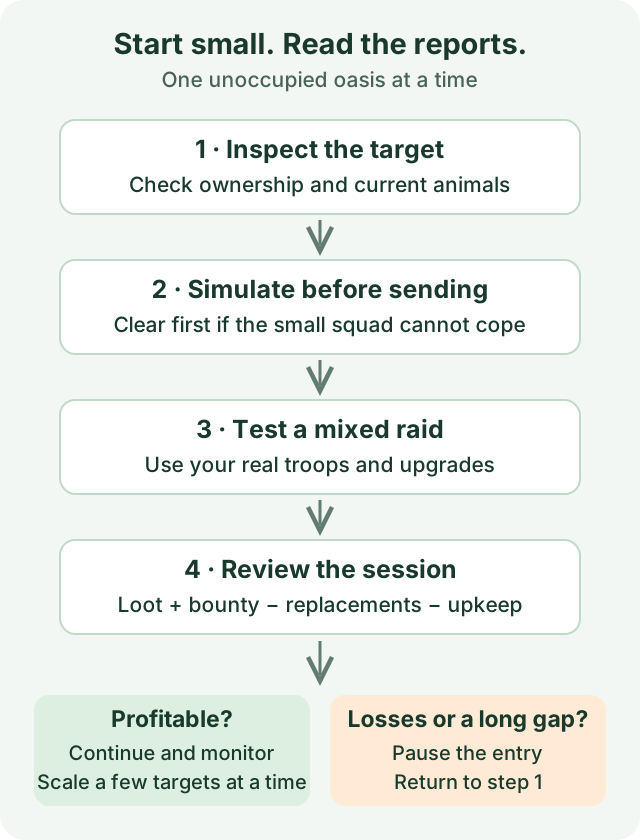
Quick start: inspect one nearby unoccupied oasis, simulate a mixed squad, clear larger animal groups first, then test repeated raids and compare the income with your losses. Recheck the target after any long break.
The aim is to deal with small animal groups before they build up, while spending as little as possible on replacements. This guide covers Travian: Legends, mainly unoccupied oases after the early protection phase. Check your world’s rules before applying it to a special server or another Travian game.
Early game: use your hero to turn animals into building resources
At server start, nearby weak animal groups can fund early buildings and settlers before you have a cavalry farm list. Inspect the animals, simulate with your hero’s actual strength, equipment and health, and compare hero alone with hero plus available troops. Send the option that earns the bounty with affordable health damage and troop losses.
You can send the hero alone when the simulation supports it. A hero who joins the fight gains experience as well as the animal resource reward; troops can earn the resource reward without the hero. Check remaining health before the next clear. Count ointments, revival and time away from adventures in the cost; do not assume every early oasis is worth clearing.
Use the initial no-respawn window: 5 days on 1x, 3 days on 2x/3x, 2 days on 5x and 1 day on 10x, measured from server start. Clearing the initial animals also unlocks that oasis’ resource production. These timings and rewards come from Travian’s early-game oasis guide.
After protection ends, move from one-off hero clears to clearing plus frequent maintenance raids. For sustained hero farming, Travian recommends fighting-strength points and equipment that improves strength, travel, experience or recovery. Level 30+ makes that allocation easier without sacrificing as much hero resource production; it is not a minimum level for an early profitable clear.
Why mix troop types instead of sending one type?
The community explanation is that casualty rounding works separately for each troop type. Splitting a small squad across types can therefore change the whole-unit losses compared with using only one type. That is the idea behind ‘rainbow’. Players describe this effect in their oasis-farming discussions; treat those explanations as practical observations, not a complete combat formula.
Mixing also changes total attack strength, so a comparison between three Steppes and a Steppe–Marksman–Marauder squad is not a pure rounding experiment. The useful question is: which squad survives the animals at this oasis for the lowest ongoing cost? Simulate both squads against the same defenders, then compare real reports.
Mixing cavalry types is different from adding infantry. Animals have separate defence values against infantry and cavalry, so a mixed infantry–cavalry army changes which defence values matter. Do not assume an infantry unit extends a tested cavalry squad’s survival threshold; simulate the complete army.
Use the Rally Point simulator with Raid selected and your actual Smithy levels. Defensive strength does not become attacking strength when you send a defensive unit out to raid. Travian’s battle mechanics guide explains the distinction and notes that adventure troops can have different upgrade levels. A mixed squad can still be wiped out; ‘rainbow’ is not a safety bonus.
Rainbow troop combinations by tribe
Travian’s official oasis farming guide gives these small cavalry combinations for iron and clay oases. Use them as simulator candidates, not guaranteed safe presets:
Do not research a whole set of units just because a list says 1/1. First compare the research, training and replacement costs with what you can earn during your actual playing hours. If your world has another tribe, use its current in-game stats rather than copying one of these combinations.
| Tribe | Send together in one raid |
|---|---|
 Huns | 1 Steppe Rider + 1 Marksman + 1 Marauder |
 Romans | 1  Equites Imperatoris + 1  Equites Caesaris |
 Gauls | 1  Theutates Thunder + 1  Haeduan |
 Teutons | 1  Paladin + 1  Teutonic Knight |
 Egyptians | 1  Anhur Guard + 1  Resheph Chariot |
 Spartans | 1  Elpida Rider + 1  Corinthian Crusher |
Pick targets and clear them before the first small raid
Start with a handful of nearby, unoccupied oases. Check ownership and visible animals on the map. An occupied oasis is a player target; it needs a different risk assessment. Travian’s oasis overview explains ownership, animal visibility and the separate rules for raiding occupied oases.
Iron and clay oases, including their crop variants, are the easier cavalry category in the official farming guide. Keep wood and crop targets separate. If a tiny squad loses in the simulator, clear the current animals with a suitable force before starting small follow-up raids.
Keep clearing and maintenance as two separate decisions. A hero-led clear may make sense, but budget its health, recovery and time away from other work. Do not send the same clearing army everywhere. Confirm the report before relying on a clear; another player or a new animal group can change the target in the meantime.
| Oasis type | First action |
|---|---|
 Iron / iron-crop | Start here: simulate a small cavalry squad; clear first if it loses. |
 Clay / clay-crop | Start here: use the same inspect → simulate → test sequence. |
 Wood / wood-crop | Keep in a separate list; farm manually until you have a tested stronger squad. |
 Crop / double crop | Recheck carefully; keep small maintenance raids disabled until simulation supports them. |
How often should you send rainbow raids?
For a cleared iron or clay oasis on a 1x world, maintain arrivals every 10 minutes with your tested small cavalry squad. Do not stretch tiny maintenance raids to 20 or 30 minutes just because that fits your schedule: animals can accumulate beyond the squad’s strength. The experienced farmers in this discussion recommend continuous ten-minute coverage.
Think in arrival times. With the same source village, squad and travel time, sending every ten minutes also produces arrivals ten minutes apart once the first raid reaches the oasis. The first arrival is still delayed by the outward journey. Changing troop composition can change that journey: a mixed army travels at its slowest unit’s speed, as described in Travian’s map and distance guide.
Example for planning only: a 30-minute trip out and 30 minutes back keeps one squad away for about 60 minutes. To send to that same target every ten minutes, allow at least six squads in rotation, plus spare troops for timing and losses. For a Hun 1/1/1 setup, that is six of each type before the spare pool. Ten similar targets would need about 60 of each. This estimates troop availability; it does not predict safe combat or profit.
The raid interval and the animal spawn timer are different things. After initial protection, animals keep regenerating; raiding kills the new animals before a large group builds up. Travian’s official help does not publish an exact timer for each animal. Ten minutes is the 1x maintenance recommendation, not a claim that exactly one animal appears every ten minutes. Faster worlds need shorter intervals; confirm the cadence for that world before using a tiny squad. Keep checking reports even with punctual sends.
After an overnight break, inspect again. Do not restart a maintenance list simply because it was safe yesterday. If the new animal group beats the squad, disable that entry until you have reassessed or cleared it.
Should you build a dedicated oasis farming village?
The same oasis farming discussion recommends a separate village near dense, less contested oases. Bounty can support other villages through hero inventory, but local travel time still determines troop availability. Players describe larger, less frequent raids as an alternative to tiny cavalry squads, with replacement costs and training time deciding profitability.
Before spending settlers or conquering a village, inspect the candidate area. Count accessible iron and clay targets, note nearby competing farmers, and calculate the rotation pool for the distances you will actually raid. Check the location with your alliance; remote farming income still needs to justify defence and development costs.
Prove the schedule first. Test a small list through a normal playing day and your usual offline gap. If each restart needs another expensive clear, compare that bill with a stronger squad used less often or conventional village farming. A dedicated village is a later investment, not a requirement to try the method.
Stored loot and animal bounty are different income streams
Stored oasis resources are carried home by surviving raiders, limited by their carrying capacity and what is available. Animal-kill bounty goes into the hero inventory. Track them separately when judging a farming session so that a small loot bag does not hide the other reward, and so that you do not count the same resources twice.
Travian’s early-game oasis guide describes the animal reward as 40 of each resource per killed animal’s crop consumption. A one-crop animal therefore represents 160 total resources; a five-crop animal represents 800. The hero does not have to accompany the raid to receive the resource reward. Hero experience is different: the hero XP guide explains that the hero must participate to earn combat experience.
Do not confuse the early server window with steady-state farming. The early-game guide gives a no-respawn window measured from server start: five days at x1, three at x2/x3, two at x5 and one at x10. This is a server-age window, not a fresh grace period when you join late. Animals start respawning when it ends.
Read the report: did this oasis pay for the losses?
For one measured session, add stored loot actually brought home and animal bounty credited to inventory. Subtract the full training resource cost of lost troops and crop consumed by the farming force during that session. Also record clearing costs, hero recovery items and any resources diverted from production into the setup. Keep item or Gold spending separate if you cannot value it consistently in resources.
Replacement time is another constraint: troops lost here cannot raid other targets until you train them again. Record how many replacements your stable can produce during the session, and keep a reserve for raids already travelling. When losses start, pause new sends to that target immediately; changing the entry does not strengthen squads already on their way.
Compare a full playing day, including the restart after a break. One green report is too small a sample, and a high raid ranking does not measure your replacement bill. If a target repeatedly earns less than it costs, pause it. More clicks do not repair a losing setup.
A profitable maintenance raid
| Unit | Sent | Lost |
|---|---|---|
| Steppe Rider | 1 | 0 |
| Marksman | 1 | 0 |
| Marauder | 1 | 0 |
- Carried loot
- +90
- Animal bounty → hero inventory
- +160
- Troop replacements
- −0
 Resources after replacements
- +250
No lost troops: keep monitoring this target.
A raid that costs more than it earns
| Unit | Sent | Lost |
|---|---|---|
| Steppe Rider | 1 | 1 |
| Marksman | 1 | 0 |
| Marauder | 1 | 0 |
- Carried loot
- +90
- Animal bounty → hero inventory
- +160
- Troop replacements
- −895
- Resources after replacements
- -645
One lost Steppe Rider costs 895 resources. Pause and reassess this target.
Animal bounty here is 40 of each resource (160 total) for a one-crop animal killed. Loot is an example total. Net excludes upkeep, clearing and hero recovery; subtract those costs for the full session.
Build a farm list you can actually maintain
Organize your in-game lists so nearby tested targets are easy to review separately from distant or experimental ones. Add only a few targets at a time. Record the squad, arrival spacing, losses and income before changing the next variable. Keep enough troops home to avoid missed sends caused by an empty stable pool.
Repeated full bags suggest there may be more stored loot to collect; test extra carrying capacity if the trip remains worthwhile. Repeated empty bags need a check of animal bounty and total cost before you remove the target. Repeated troop losses need a new simulation, a stronger squad, a different interval or a pause. Choose from the reports rather than scaling every entry together.
Use Battle Reports to review reports you import into TraviTools. Farm-list entries and sending stay in Travian. For village farms, use the Inactive Finder alongside the inactive-player guide, then scout: an inactivity estimate does not establish an empty defence. Village walls, passive defence and traps mean an oasis squad is not automatically a safe village squad.
Before investing in a dedicated farming village, prove that a small list stays profitable through your normal schedule. Compare that investment with your second-village plan, crop development and alliance needs. A setup that requires attention you cannot give it is a poor fit even if another account farms successfully with it.
Common questions
What does 1/1/1 mean in Travian rainbow farming?
For the Hun example, it means one Steppe Rider, one Marksman and one Marauder sent together in one raid. It does not mean three separate waves.
Is rainbow farming always loss-free?
No. A mixed squad can still lose troops or be wiped out. Simulate the current animals with your actual upgrades and check reports, especially after a break.
How often should I send rainbow raids?
On a 1x world, maintain arrivals every 10 minutes at cleared iron and clay oases with a tested small cavalry squad. Longer gaps can let animals overwhelm it. Faster worlds need shorter intervals; check that world’s cadence. After a break, inspect and clear again before restarting tiny raids.
Does the hero need to join every oasis raid?
No. Animal-kill resource bounty is credited to the hero inventory without the hero joining the raid. Combat experience requires the hero to participate.