
About one in three opening-day accounts hits a growth pause
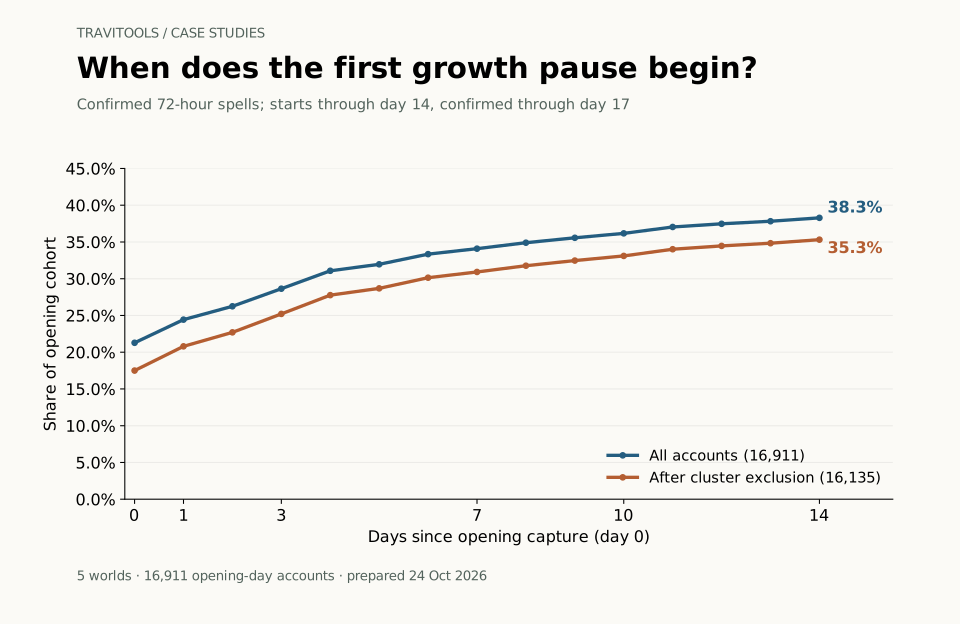
Across five new worlds, 6,474 of 16,911 accounts (38.3%) had a confirmed three-day pause beginning within 14 days of the opening capture. Our main cluster exclusion removes 776 low-growth accounts, leaving 5,698 of 16,135 (35.3%). Those are observed account records, not unique people.
We define a pause as four consecutive daily observations with identical total population and village count, spanning 72 hours. The first flat observation dates the start; three more daily captures confirm it. A missing record, a shrinking population or a changed village count cannot complete that spell.
That is a useful inactivity signal, but it does not tell us when someone last logged in or whether they permanently quit. Training troops can leave population unchanged, and growth and losses can cancel between daily captures. Travian’s official map.sql documentation lists population and village information, but no login history.
How soon does the first pause begin?
Day 0 is each world’s opening capture, taken within 24 hours of launch. It is not the exact signup time. We follow the accounts for another 17 daily intervals so a spell beginning on day 14 has time to be confirmed on day 17. Later registrants are outside this launch cohort.
21.3% were already flat from the opening capture, confirmed over the following three days. After the cluster exclusion, that falls to 17.5%. By day 7, spells had begun for 34.1% of the original cohort, compared with 30.9% after exclusion.
The median first-pause start among observed cases is day 0 in the full cohort and day 1 after the main exclusion. That describes the recorded start of qualifying pauses. It cannot establish that half of all players quit on their first day.
| Start observed by | All 16,911 accounts | After exclusion: 16,135 |
|---|---|---|
| Opening capture | 21.3% | 17.5% |
| Day 1 | 24.4% | 20.8% |
| Day 3 | 28.6% | 25.2% |
| Day 7 | 34.1% | 30.9% |
| Day 14 | 38.3% | 35.3% |
How far do accounts get before their first pause?
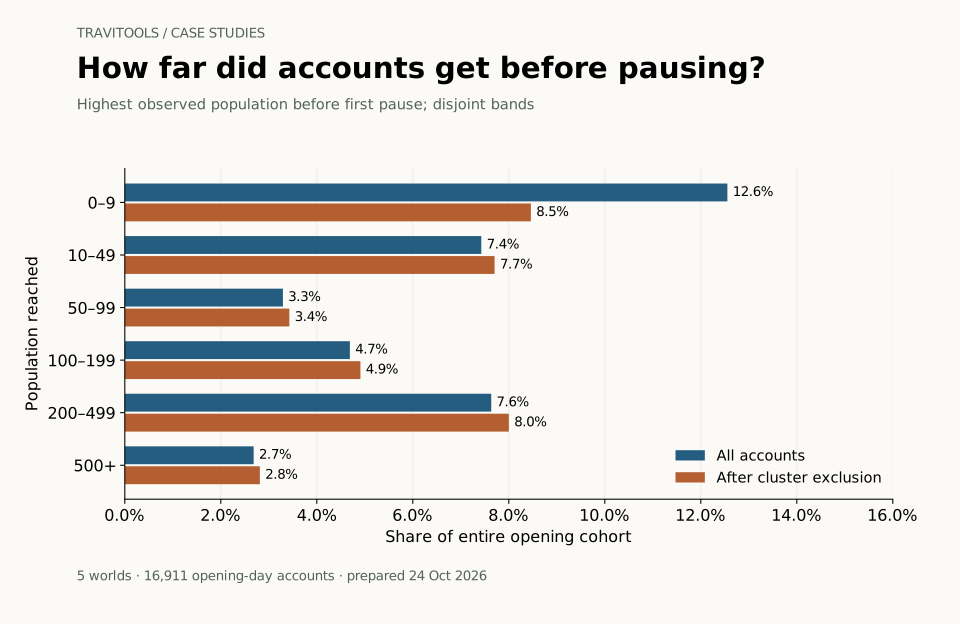
2,123 accounts (12.6%) paused without having reached 10 population in our observations. 3,379 (20.0%) had not reached 50. After removing the flagged clusters, those shares become 8.5% below 10 and 16.2% below 50.
We use the highest population observed from the opening capture through the start of the first pause. An account that reached 120, fell to 40 and then stalled belongs above the 100-population threshold; it did not fail to reach 50. Development before the opening capture is not visible.
These thresholds overlap: below 50 includes below 10. Every percentage below divides by the entire corresponding cohort, including accounts without a confirmed pause. It is not the chance of quitting after reaching that population. A higher band can have a larger percentage after filtering because the denominator shrinks; the filtering does not add accounts.
| Highest observed population | All accounts: count / share | After exclusion: count / share |
|---|---|---|
| Below 10 | 2,123 / 12.6% | 1,365 / 8.5% |
| Below 50 | 3,379 / 20.0% | 2,608 / 16.2% |
| Below 100 | 3,936 / 23.3% | 3,161 / 19.6% |
| Below 200 | 4,729 / 28.0% | 3,953 / 24.5% |
| Below 500 | 6,020 / 35.6% | 5,244 / 32.5% |
The bot concern: dense pockets of barely developed accounts
The concern is a group of throwaway accounts created near a beneficiary account, leaving a buffer of inactive villages instead of developing neighbours. A cluster of low-growth accounts is consistent with that possibility. It can also arise from ordinary early abandonment and the game’s spawning pattern. Public maps cannot establish automation, common ownership, a beneficiary, or a paid service.
Our candidate rule requires a confirmed pause, one village throughout observed follow-up, no observed population decrease, and fewer than 10 population gained between the first observation and the maximum observed population. We follow each account until day 17 or its first disappearance. This is a growth threshold, separate from an absolute population below 10.
We flag a candidate only if at least 10 candidates, including itself, are within five map tiles by straight-line distance, and candidates make up at least 60% of all opening-cohort capitals within that radius. All candidates appeared in the opening capture; daily sampling cannot prove they registered simultaneously. Distances do not wrap at map edges. Accounts that vanish before a pause can be confirmed, bots that develop normally and clusters created after the opening capture are not caught by this rule.
The coordinates come from archived opening maps, joined to each account’s initial capital. Coverage is 100% of the included cohort. Using only today’s village registry would miss many accounts that subsequently disappeared and weaken precisely the check we need here.
This rule flags 776 accounts, of which 756 are on the regular International 3x world. The first-pause rate falls by 3.0 percentage points, from 38.3% to 35.3%; the below-10 share falls by 4.1 points. This is a sensitivity analysis. We do not call the retained accounts human or the excluded accounts proven bots, and we publish no suspected-account names or coordinates.
How much does the answer depend on the cluster rule?
A tighter radius flags almost nobody; a wider radius flags more. Requiring 20 candidates instead of 10 also removes almost nobody. The density definition matters, so there is no defensible single ‘bot-corrected’ dropout rate in this dataset.
As a deliberately broad comparison, removing all 3,675 low-growth candidates, regardless of location, leaves 13,236 accounts and a 21.1% first-pause rate. That removes genuine newcomers too, and selects accounts using their later development. It is a stress test, not a better estimate of human behaviour.
| Distance / minimum candidates | Accounts excluded | First-pause share of retained cohort |
|---|---|---|
| 3 tiles / 10 accounts | 1 | 38.3% |
| 5 tiles / 10 accounts | 776 | 35.3% |
| 8 tiles / 10 accounts | 951 | 34.6% |
| 5 tiles / 20 accounts | 2 | 38.3% |
A pause, a disappearance and a permanent quit are different outcomes
4,594 accounts (27.2%) disappeared from observation before we could confirm a pause. They remain in the original denominator and are not counted as first-pause events. Another 3,370 disappeared after a confirmed pause. We stop follow-up at the first missing account record; none reappeared in the remaining study window.
Deletion, conquest of a final village, enforcement or another map-visible change can remove an account. These records do not reveal which cause applies. Because disappearances may relate to low activity or enforcement, we do not assume they are random censoring and do not extrapolate a survival curve for human retention. The reported pause shares are observed event proportions, not complete quit probabilities.
A stricter seven-day flat spell began by day 7 for 4,056 accounts (24.0%), compared with 20.4% after the main cluster exclusion. This compares spells starting by day 7, with confirmation by day 14, so both definitions have enough follow-up.
Separately, 3,068 accounts (18.1%) were still present and flat across days 11–14. At least 250 accounts grew again after their first confirmed pause before observation ended. Follow-up after confirmation varies, so that count is not a return rate or proof the other accounts never returned.
Compare worlds before drawing conclusions about speed
The sample contains one 1x world, one 2x, two 3x and one 5x. International 3x alone supplies 51.2% of accounts and most cluster flags. Pooling the worlds weights large cohorts more heavily; an overall percentage is not an equally weighted typical-server estimate.
The ROG 3x world has the highest raw pause share in this small sample, but one special world does not establish a game-mode effect. Speed, ruleset, launch date, community and possible artificial accounts differ together. These are world comparisons, not a ranking of which speed retains real players best.
| World | Accounts | All accounts | After cluster exclusion |
|---|---|---|---|
| ts50.x5.europe | 3,582 | 38.5% | 38.5% |
| ts10.x1.america | 2,050 | 35.1% | 34.5% |
| ts21.x2.asia | 1,008 | 36.5% | 36.4% |
| ts33.x3.international | 8,662 | 38.7% | 32.9% |
| rog.x3.international | 1,609 | 40.5% | 40.5% |
What this means for players and alliances
A quiet low-population neighbourhood can make a new world look emptier than its signup count suggests. Compare several snapshots, look at who is still developing nearby, and inspect whether tiny accounts form dense pockets before treating raw account totals as a count of real opponents.
For alliance recruitment, population growth is a screening signal, not a replacement for a conversation about availability. For farming, no growth does not mean no troops or a safe target. The inactive finder can help shortlist accounts near you; verify protection and the in-game situation before acting.
Travian’s official rules FAQ prohibits multiple accounts on the same world and private farms created to benefit others. Enforcement needs evidence beyond the population patterns measured here. This study does not identify a service provider or accuse individual accounts.
Coverage, definitions and reproducibility
Prepared on 24 October 2026. We screened seven tracked worlds launched from 24 September through 6 October. Asia 1x and Arabics 1x were excluded because their first retained player captures were more than 24 hours after launch. The five included worlds launched from 28 September through 5 October and have 18 consecutive daily captures, covering day 0 through day 17 of each opening cohort.
We use the stored current-round launch boundary and exclude NPC tribes Nature and Natars and account IDs of 1 or lower. Each account enters once, in its world’s first capture. This omits registrants who arrived later and accounts that vanished before the opening capture. Accounts shared by several people count once; the same person on different worlds can count more than once.
Days measure elapsed real time, not speed-adjusted game time. Daily snapshots cannot resolve within-day activity or exact registration times. Peak population means the maximum observed before the first qualifying spell. Cluster candidates are selected retrospectively using observed development through disappearance or day 17; this is not a prospective bot detector.
Download the anonymous aggregate results, world dates and exclusion list. The read-only extraction, analysis and chart scripts are retained with the article source. Only world-level aggregates are published; raw account identifiers and opening coordinates remain outside the public assets. The five-world convenience sample is not a worldwide Travian retention census.
Common questions
Does unchanged population prove a Travian player quit?
No. This study detects 72-hour periods with unchanged account population and village count. It cannot observe logins, troop training or permanent quitting.
How many new accounts paused before reaching 10 population?
In this five-world opening cohort, 2,123 of 16,911 accounts (12.6%) had a confirmed pause before reaching 10 observed population. After a spatial low-growth cluster exclusion, that becomes 1,365 of 16,135 accounts (8.5%). The exclusion does not identify proven bots.
Were disappearing accounts counted as inactive?
No. Observation stops at the first missing account record. The 4,594 accounts that disappeared without a confirmed pause stay in the original denominator but are not counted as pause events.