
The result: seven months at 1x, about four weeks at 10x
The median final recorded game days in our cleaned sample are 211 at 1x, 109 at 2x, 72 at 3x, 43 at 5x and 27 at 10x. These describe the archive records we measured, rather than a guaranteed finish date for your next round.
Our sources are the public 2025 archive and 2026 archive from Getter-Tools. We measure their final recorded game day: an age proxy, not a verified World Wonder winning timestamp.
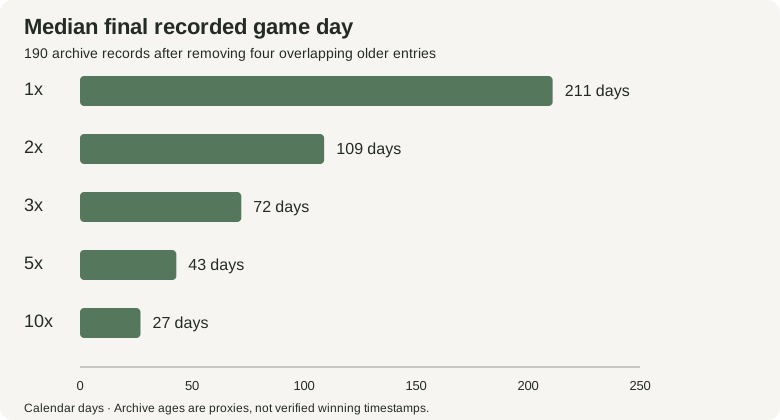
The distribution matters more than one example
The middle 50% spans the 25th to 75th percentiles, using linear interpolation between sorted records. It describes the central spread of this sample; it is not a prediction interval. The full range retains unusual records, including ages that need independent verification.
| Speed | Records | Median days | Middle 50% | Full range |
|---|---|---|---|---|
| 1x | 99 | 211 | 209–215 | 204–459 |
| 2x | 19 | 109 | 106.5–111 | 104–126 |
| 3x | 41 | 72 | 71–73 | 70–108 |
| 5x | 17 | 43 | 43–44 | 28–56 |
| 10x | 14 | 27 | 24–29.75 | 23–33 |
What we included, and what we left out
The selection rule was fixed by hostname: ts followed by a number, an explicit x1, x2, x3, x5 or x10 speed, and one of the America, Arabics, Asia, Europe or International domains. We included every matching row exposed in those two archive tables with a final-update date no later than 31 October 2026. Archive year means the table it appears in, not necessarily its start year.
That scope excludes Kingdoms, named local worlds, Annual Specials, tournament hosts and test worlds. It is a study of numbered-server archive coverage, not every Travian round worldwide. A hostname alone also cannot prove that every round used identical mechanics.
Speed is taken from the hostname. The archive labels the x5 hosts as ‘Speed 3x’, so those records have a source-label conflict. We retain them under hostname speed and preserve both fields in the download for inspection.
Four overlapping entries, and the outliers we kept
We found four older entries whose hostname and final-update date also occur on a newer-start entry. For the main analysis we kept the newest start in each such group. The removed ages were 465 and 460 days at 1x, and 176 and 282 days at 3x. This is a stated overlap heuristic, not proof that the older rounds never existed.
Keeping all 194 rows produces the same median in every speed group. The headline results therefore do not depend on those four removals. Their ranges do: the raw 1x maximum is 465 days and the raw 3x maximum is 282 days.
We did not silently discard the remaining extremes. The 1x sample still contains a 459-day record for ts5.x1.arabics, starting 21 December 2023. The 3x maximum is 108 days; the 5x minimum is 28. These are archive observations requiring follow-up, not evidence of confirmed 459-day or 28-day victories. The 28-day record even precedes today’s standard 5x plan release on day 36, so it cannot be read as a normal victory under that timetable. Historical rules, speed-label conflicts or tracking problems need checking. An archive that continues updating a reused hostname can overstate a round’s duration.
Do the two archive years tell a similar story?
Splitting the sample by archive year checks whether pooling hides a large shift. The medians are close across years, although the smaller speed groups remain thin. This is a descriptive check, not a statistical test of changes in game balance or player behaviour.
| Speed | 2025 median (n) | 2026 median (n) |
|---|---|---|
| 1x | 210 days (n=55) | 212 days (n=44) |
| 2x | 109 days (n=11) | 108.5 days (n=8) |
| 3x | 72 days (n=24) | 71 days (n=17) |
| 5x | 44 days (n=9) | 43 days (n=8) |
| 10x | 27 days (n=6) | 27 days (n=8) |
Why dividing by speed is only an approximation
Using 211 days as the 1x baseline would predict 105.5 days at 2x, about 70.3 at 3x, 42.2 at 5x and 21.1 at 10x. The observed medians are 109, 72, 43 and 27. The largest proportional gap is at 10x: roughly 28% above the simple division estimate.
That is an association across different rounds, not a controlled experiment. Different alliances, launch dates, rules and archive update behaviour can contribute. These records do not let us assign the difference to any one cause. For choosing a world, the measured speed-group distribution is more useful than treating 1x duration divided by speed as a promise.
How the recorded ages compare with the official endgame clock
The official World Wonder rules say a regular Legends round ends when a player or the Natars reaches World Wonder level 100. The official speed table provides these construction-plan and Natar milestones. They are current rules, not independently checked historical settings for every archived round.
| Speed | Construction plans | Archive median | Natar WW completion |
|---|---|---|---|
| 1x | 180 | 211 | 250 |
| 2x | 90 | 109 | 160 |
| 3x | 60 | 72 | 95 |
| 5x | 36 | 43 | 71 |
| 10x | 18 | 27 | 35.5 |
Annual Specials need a separate estimate
Annual Specials have scheduled durations rather than the regular World Wonder finish. The official speed table lists 180 days at 1x, 120 at 2x, 80 at 3x, 50 at 5x and 30 at 10x. Those are published schedules, not findings from the numbered-server sample.
Confirm the individual world’s announcement. Our game modes guide explains regional Victory Point competition. Mixing these fixed-duration worlds into a World Wonder sample would answer a different question.
Use the results to plan a commitment, not a countdown
For an ordinary numbered world, start with the median and central spread for its speed. Roughly seven months at 1x, three and a half months at 2x, ten weeks at 3x, six weeks at 5x and four weeks at 10x describe the scale of commitment in this sample. Allow for a later finish when arranging holidays or account coverage.
Your remaining time depends on the world’s age, not your account’s age. At day 150 on a 1x world, subtracting from the sample median gives 61 days, but that is only a planning reference. The actual World Wonder race matters more once plans are available. For scheduled worlds, use the announced end time instead.
A shorter round does not necessarily mean fewer hours online: faster play can concentrate the workload. Check the server list, then agree coverage with your team before registering.
Download the data and understand the limits
The record-level CSV contains all 194 selected rows, source links, original version labels and explicit inclusion flags. The summary JSON contains the calculated counts, medians and quartiles. The retained data can be recomputed with the repository’s scripts/analyze-server-duration.mjs script.
This sample depends on one archive’s coverage and update behaviour. Offline status and a final game day do not confirm the winner or exact end time. Active rounds are absent, and recently launched long rounds cannot yet enter the archive, which can favour shorter completed rounds. The observations are also grouped by regional launch schedules rather than independent random draws.
The medians are useful descriptive evidence for this selected archive sample. A verified study of winning times would additionally need official result timestamps or a reliable round-specific end-event record. We do not have those for these 190 retained records.
Common questions
How long does a 1x Travian server last?
In this archive study, 99 retained 1x records have a median final recorded age of 211 days, with the middle 50% between 209 and 215 days. These archive ages are duration proxies, not confirmed winning timestamps.
Does a 10x server last one tenth as long?
The median final recorded age was 27 days across 14 retained 10x records. Dividing the 1x median of 211 by ten gives 21.1 days, so simple division understates the 10x median in this sample.
Do Annual Specials end with a World Wonder?
Annual Specials use scheduled durations and regional Victory Point competition. Confirm the particular world’s announcement rather than applying a regular World Wonder timeline.