The ranking: nearly one in two accounts is recorded as Gaul
Tribe availability matters: Travian’s game-version guide lists Spartans on special six-tribe worlds, not on every server. The chart below describes the combined footprint across our tracker; it is not a fair comparison of player preference when everyone has the same choices. Below, we split the sample into its three exact observed tribe combinations: 35 three-tribe worlds, 15 five-tribe worlds, and 11 six-tribe worlds. Each world belongs to exactly one group. These recorded combinations are a proxy for availability, not a verified list of signup choices.
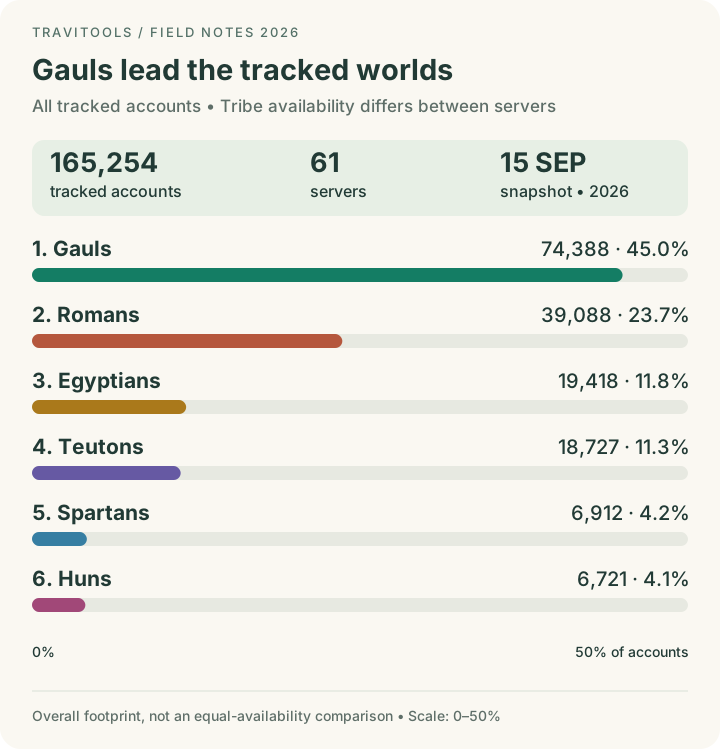
Gauls lead with 74,388 accounts, ahead of 39,088 Romans. That is a 21.4 percentage-point gap, or about 1.9 Gaul accounts for every Roman account. Gauls also rank first on 56 of the 61 servers; Romans lead on four and Egyptians on one. The lead is spread across the sample, rather than coming from a single enormous world.
The full order is Gauls: 74,388 (45.0%); Romans: 39,088 (23.7%); Egyptians: 19,418 (11.8%); Teutons: 18,727 (11.3%); Spartans: 6,912 (4.2%); and Huns: 6,721 (4.1%). Percentages are rounded independently.
This is a snapshot of accounts present on tracked maps at 00:01 UTC on 15 September 2026. It is not a full-year census, a ranking of active humans, or a measure of which tribe wins most often. On mixed-tribe worlds, the stored account tribe is a proxy; the methodology below explains exactly how it is assigned.
Why Gauls lead—and why Romans remain a strong second
There is a concrete coverage advantage: Gauls, Romans, and Teutons appear on all 61 included worlds. Egyptians and Huns appear on 26, and Spartans on 11. A tribe with a smaller footprint has fewer worlds in which it can accumulate accounts. Presence does not prove which tribes were selectable when a server opened, but it shows why the pooled ranking is sensitive to the sample.
Playstyle offers a plausible explanation for Gauls’ broad appeal. Their defensive tools, Trapper, and fast units suit players who value a safer start and flexible support. Romans offer versatile armies and simultaneous construction of a resource field and a building. Those features can appeal to a broad range of players. These are our interpretations of the mechanics described in Travian’s official tribe overview, not reasons measured by our snapshots.
We do not have a survey of player choices, login activity, or a controlled comparison of retention. Starting preferences, account survival, server age, and special-world rules can all affect the accounts still visible today. The data establish Gauls’ lead in this sample; they cannot establish how much of that lead any one mechanic caused.
Compare the tribe combinations
Choose a server group to compare its tribes. Each slide uses only accounts from worlds with that exact observed combination.
Three tribes: Romans, Gauls, and Teutons
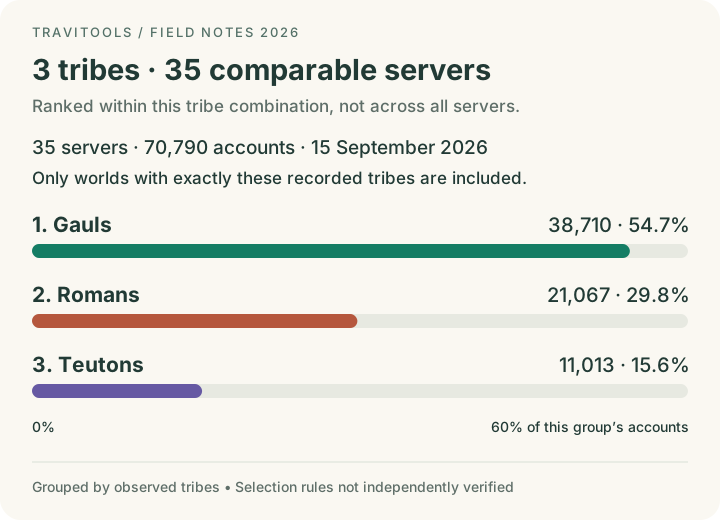
The 35 worlds in this group contain only recorded Romans, Gauls, and Teutons: 70,790 accounts in total. Gauls lead with 38,710 (54.7%), followed by Romans with 21,067 (29.8%) and Teutons with 11,013 (15.6%). No accounts from worlds with additional recorded tribes enter these percentages.
Gauls have the largest account count on 34 of these 35 worlds; Romans lead on the other one. This tells us about the classic three-tribe group. It says nothing about a direct choice between Gauls and Spartans, because Spartans are not represented here.
Five tribes: the classic three plus Egyptians and Huns
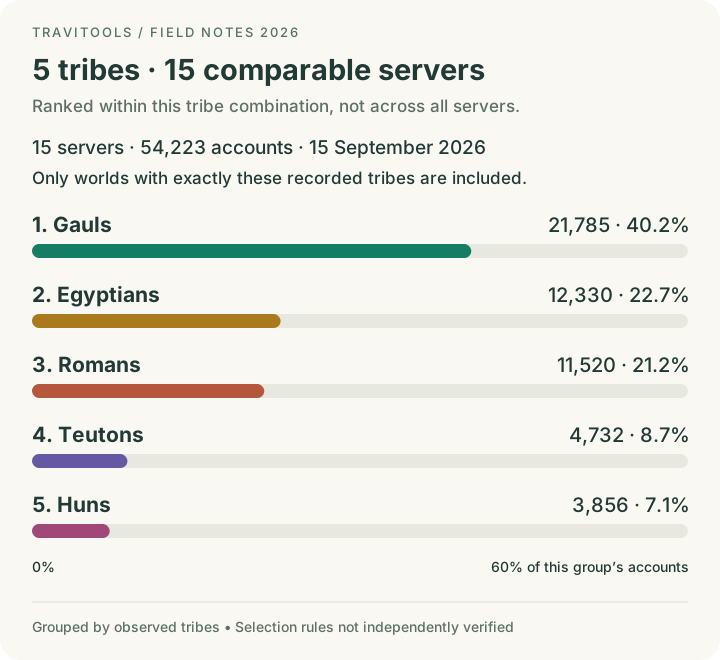
These 15 worlds contain 54,223 accounts and exactly five recorded tribes. Gauls lead with 21,785 (40.2%), Egyptians are second with 12,330 (22.7%), and Romans are third with 11,520 (21.2%). Teutons have 4,732 (8.7%) and Huns 3,856 (7.1%). The six-tribe worlds are excluded, so Spartans do not dilute or enter this comparison.
Gauls lead on 12 of the 15 worlds, Romans on two, and Egyptians on one. The group average therefore does not describe every individual server. Egyptians’ economic and defensive strengths are a plausible source of appeal, as described in Travian’s Egyptian guide, but these snapshots do not measure why players choose them.
Gauls’ share is lower here than in the three-tribe group. That is a difference between separate server groups—not proof that individual players switched from Gauls to Egyptians or Huns.
Six tribes: add Spartans, compare the same 11 servers
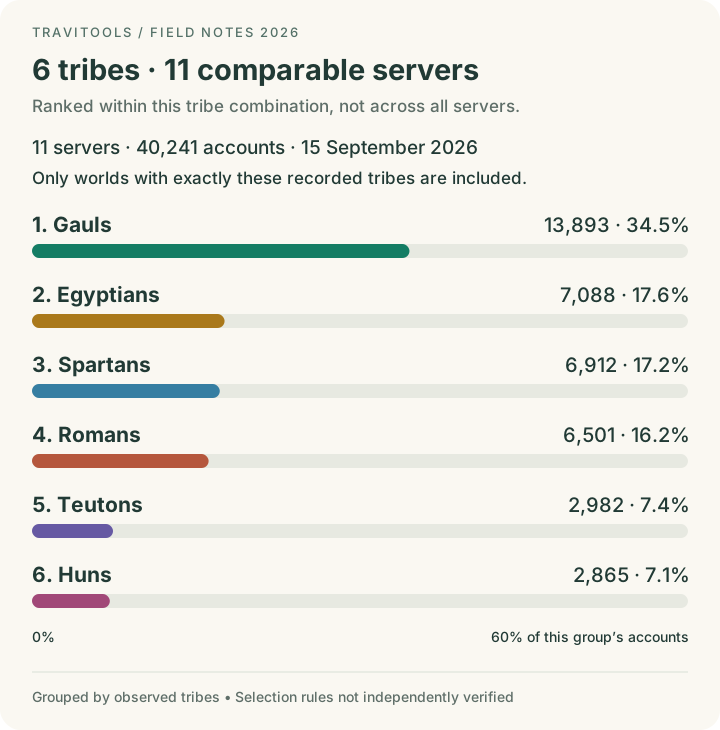
To compare Spartans with the other tribes more meaningfully, we keep only worlds where all six tribes appear in our account summaries. That leaves 11 servers with 40,241 accounts. Every percentage below uses that same total: accounts recorded as a tribe divided by 40,241. We do not compare each tribe against a different set of servers.
In this shared group, Gauls lead with 13,893 accounts (34.5%). Egyptians follow with 7,088 (17.6%), then Spartans with 6,912 (17.2%), Romans with 6,501 (16.2%), Teutons with 2,982 (7.4%), and Huns with 2,865 (7.1%). Spartans are third here, rather than fifth in the overall totals, and only 176 accounts behind Egyptians.
The Spartan count stays at 6,912 in both charts. What changes is the comparison group: the first chart includes another 125,013 accounts on 50 worlds without recorded Spartans. Removing those worlds gives us a more comparable view of the six tribes. It does not mean Spartans gained players between snapshots—both charts use the same date.
This is a closer comparison, not a controlled test of signup preferences. We identify the group from observed tribes, rather than an independently verified list of selectable tribes. Special-world rules, mixed-tribe accounts, server age, region, and account survival still matter. Gauls have the largest count on 10 of these 11 worlds; Romans lead on the other. This is an account-count ranking, not a claim that Gauls beat Spartans in every matchup.
What the lower ranks do—and do not—mean
Teutons’ cheap, quickly trained raiding troops support an offensive playstyle. Huns emphasize mobile cavalry and aggressive raiding, as described in Travian’s Huns guide. Those roles may appeal to a different audience from defensive or economic play. Our snapshots contain no player-intent data, so specialization is a possible explanation, not a measured cause of their shares.
Spartans are fifth in the overall account totals but third within the 11-world shared group. Their smaller server footprint depresses the overall percentage; neither ranking measures combat strength.
For your next server, use this ranking as context. Match your tribe to the world’s rules, your time commitment, and your alliance role. An account-count lead does not measure combat efficiency, player skill, or the best choice for your own game.
Methodology and coverage
Prepared on 16 September 2026 using TraviTools’ tracked-world registry and stored player summaries. We inspected 153 registry entries: 61 active, online production worlds had player summaries at the common 15 September, 00:01 UTC cutoff. We excluded 88 entries not marked both active and online, one alpha test world, and three entries without a snapshot at that cutoff. Ended worlds and earlier rounds are not represented in this point-in-time comparison.
Each world uses exactly one capture. We read every page of player summaries, checked the returned totals for completeness, and rejected duplicate player IDs within a world. Accounts with IDs of 1 or lower and the NPC tribes Nature and Natars are excluded. The denominator is 165,254 eligible account-world records, including accounts that may be inactive but remain on the map. The same person on two worlds counts twice; shared accounts do not reveal how many humans use them.
The capture pipeline stores the tribe of the first village encountered for each account. That matches the tracker’s existing account-level summary, but on worlds that preserve conquered village tribes or allow mixed-tribe settlement it may not identify the original signup tribe or the majority of an account’s villages. These are rankings of recorded account tribes, not a reconstruction of registration choices.
This is the coverage of our tracker at the cutoff, not a random sample of all Travian servers. Differences in region, speed, server age, rules, and account retention can affect the totals. A single date cannot establish whether a tribe gained or lost popularity during 2026.